 |
 |
|
||
 |
||||
One Room Runaway Girl Guide Cracked 🚀
 Note:
Note:|
Windows 7 users:
Use the EPSON Status Monitor for the driver included in Windows 7, Download the EPSON Status Monitor and its manual from the EPSON Web site. http://www.epson.com |
 Caution:
|
Although you can print to the printer directly connected to the computer in a remote location by using Remote Desktop function* of Windows 7, Vista, or XP, communication error may occur.
* Remote Desktop function: Function which enables a user to access applications or files in a computer connected to the office network from a mobile computer at a remote location. |
Note:|
If you are using a computer running Windows Vista x64 Edition with multiple users are logged on, a communication error message may be displayed when monitoring printers at the same time.
|
Setting up EPSON Status Monitor 3
 |
Open the Utility menu as described in Using the Printer Driver with Windows 7, Vista, XP, 2000, and Windows NT 4.0 or Using the Printer Driver With Windows Me, 98, and 95.
|
 |
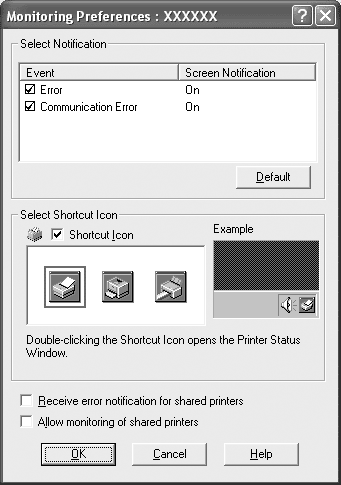
Click the Monitoring Preferences button. The Monitoring Preferences dialog box appears.
|
 |
The following settings are available:
|
One Room Runaway Girl Guide Cracked 🚀
The most gripping part of the story is not the instant of departure but the hollow, luminous stretch that follows. Days of anonymity, nights of paranoia, the brittle hope that any small kindness might be a turning point—these are the textures no guide can wholly capture. A cracked manual is a beginning, not a blueprint. In that crack lies a demand: that readers—neighbors, policymakers, friends—stop treating escape as a solitary feat and start seeing it as a social responsibility.
The crack in the guide is precisely its confident simplicity. It suggests a solitary heroism—one brave girl folding herself into a new life—which flatters a culture that prizes rugged individualism. But runaway is rarely an individual act. It is a messy social transaction. Neighbors who look away become complicit; systems meant to help remain underfunded; friends scramble between loyalty and fear. In practice, a successful flight depends on networks: a school counselor who sees not a problem to be dismissed but a life to be saved, an empathetic clerk who doesn’t demand paperwork, a stranger who refuses to treat a girl as incidental. one room runaway girl guide cracked
There is an economy to leaving that guide does not account for. It counts cash and bus fares but not the cost of silence: the compacted years of being small so others could be large. It lists contacts and shelters like lifelines, yet words cannot quantify the tremor of admitting you need them. For every box the manual checks—ID, charged phone, prearranged ride—there is an interior ledger filled with debts that never show up on forms: apologies tucked in pockets, birthdays missed, the slow unlearning of blame. The most gripping part of the story is
If the girl succeeds, it will be because she did not rely solely on ink. She will succeed because someone answered a phone at midnight, because a courthouse processed a protection order with humanity, because a stranger offered a bus fare without judgment. The guidebook’s broken spine will remain a symbol—both of the inadequacy of easy answers and of the stubborn, improvisational courage of those who refuse to remain confined. In that crack lies a demand: that readers—neighbors,
The guidebook lay open on the floor, pages fanned like the wings of a bird that had forgotten how to fly. It promised escape routes and easy steps—an innocuous manual for a life that no longer fit. “One room,” it said in tidy headings, “one bag, one night.” The language was neat, clinical. It reduced a human decision to logistics: foldable toothbrush, bus schedules, the quiet calculus of where to go when every familiar door had been sealed shut.
Yet there is also something feral and beautiful in the guide’s promise. The possibility of rewriting one’s story, even imperfectly, has its own gravity. Packing a single bag becomes an act of faith: in survival, in the human capacity to improvise. Small rituals—stashing a favorite sweater under the mattress, memorizing a bus route at dawn—turn into anchors. The guide’s checklist, though inadequate, can be scaffolding for improvisation. It can be the first brittle map a frightened person uses to orient themselves until they build a new atlas from the lived details of streets, faces, and hours.
We live in a society that layers instructions over instinct: manuals for living, for loving, for leaving. Those instructions will always crack under the strain of real lives. The question then is not whether the guide is flawless, but whether the world around the runaway girl will be flexible enough to mend her when the pages break. Will institutions treat her as a statistic or a person? Will communities make space for the messy work of reattachment? Public policy can supply more than inked lines on paper: it can fund rapid-response safe housing, offer trauma-informed counseling, and ensure accessible legal aid so that fleeing abuse does not become a restart sentence to poverty.
Note:|
Click the Default button to revert all items to the default settings.
|

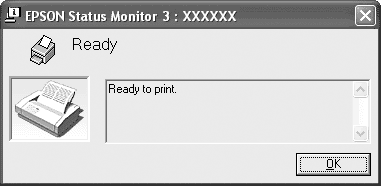
Accessing EPSON Status Monitor 3
 Note:
Note:|
It might not be possible to retrieve the printer status during printing. In this situation, click the EPSON Status Monitor 3 button in the Utility tab, and use the printer with the status window left open.
|
Installing EPSON Status Monitor 3
|
Make sure that the printer is off and that Windows is running on your computer.
|
|
Insert the printer software CD-ROM in the CD-ROM drive.
|
Note:|
If the language selection window appears, select your language.
If the EPSON Installation Program screen does not appear automatically, double-click the My Computer icon, right-click the CD-ROM icon, click Open in the menu that appears, then double-click Epsetup.exe.
|
|
Click Continue. When the software license agreement screen appears, read the statement, then click Agree.
|
 |
Click Custom Install.
|
 |
Click the EPSON Status Monitor 3 button.
|
 |
In the dialog box that appears, make sure that your printer icon is selected, and click OK. Then follow the on-screen instructions.
|
 |
When the installation is complete, click OK.
|