Basics


Info Download

Advanced

v/v
V
V

Plot Download

Punjabi Aunty Pradhi Having Sex With Her Partner Mms Wmv Top [DIRECT]

Despite the changes in their roles, Indian women continue to be an integral part of the country's cultural fabric. They are known for their rich cultural heritage, which is reflected in their traditional attire, jewelry, and accessories. The sari, for example, is a timeless and iconic garment that has been a staple of Indian women's clothing for centuries. Similarly, Indian women are known for their love of jewelry, with many traditional pieces featuring intricate designs and precious stones.

Traditionally, Indian women played a vital role in maintaining the household and taking care of their families. They were responsible for managing the household chores, cooking, and childcare. However, with the passage of time, Indian women have increasingly become part of the workforce, with many pursuing careers in various fields such as education, healthcare, technology, and entrepreneurship. punjabi aunty pradhi having sex with her partner mms wmv top

Indian women have also made significant contributions to the country's artistic heritage. Many Indian women have excelled in fields such as music, dance, and literature. The country has produced several renowned female artists, including writers such as Arundhati Roy and Jhumpa Lahiri, and musicians such as Lata Mangeshkar and Asha Bhosle. Despite the changes in their roles, Indian women

In conclusion, the lifestyle and culture of Indian women are a reflection of the country's rich cultural heritage and its complex social dynamics. Indian women have made significant contributions to the country's cultural, artistic, and economic development, and they continue to play a vital role in shaping the country's future. While there are still several challenges that Indian women face, there is a growing recognition of the importance of empowering them, and efforts are being made to promote their rights and opportunities. Similarly, Indian women are known for their love

In recent years, there has been a growing recognition of the importance of empowering Indian women. The Indian government has launched several initiatives aimed at promoting women's empowerment, including programs to improve education, healthcare, and economic opportunities. Many NGOs and community organizations are also working to promote women's rights and empowerment.

The lifestyle and culture of Indian women are rich and diverse, reflecting the country's complex history, geography, and social dynamics. Indian women have made significant contributions to the country's cultural heritage, and their lives are a testament to the country's vibrant traditions and customs.

In addition to their cultural contributions, Indian women have also played a crucial role in the country's social and economic development. Many Indian women have become leaders in their communities, working to promote education, healthcare, and women's empowerment. The country has also seen a rise in female entrepreneurs, with many women starting their own businesses and creating jobs for others.
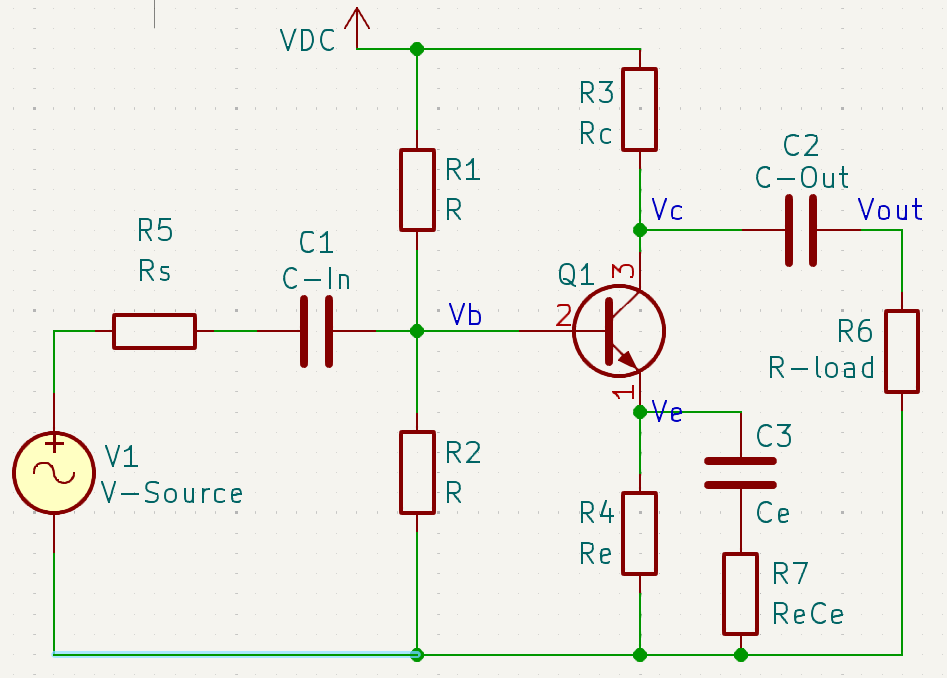
Disclaimer: This tool is provided for educational and illustrative purposes only. No guarantee is made regarding accuracy, suitability, or performance. Use at your own risk. - Copyright: ufelectronics.eu / Andreas Dyhrberg

×
Amplifier Schematic
×

There are different ways to calculate an amplifier, depending on what you want to achieve.

Maybe you want to achieve a certain gain, as far as possible (classic mode). Or you have a low Vcc to respect (modern mode). Or you work with analog audio amps (symmetry mode).

Depending on what you want to achieve and the way of calculating it. Some fields might become dependent on others, or the other way around.

Your above choise makes some input fields available for manipulation, while hiding others.


🎯 1. Target Gain (Av) — "Classic mode"

You care about how much your amplifier multiplies the input signal.

Set desired voltage gain and Rc voltage drop. Best for learning and simple amplifiers.

You say: “I want a gain of 10.”
The app adjusts resistors to try and match that.
You must give Av and Vrc (the voltage dropped across Rc).

Best for common emitter amplifiers.

✅ Default choice for most beginners and educational use.


⚡ 2. Target Emitter Voltage (Ve) — "Modern mode"

You care about setting a healthy DC bias point.

Prioritize stable biasing via Ve. Useful for low-voltage circuits or precision designs.

You say: “I want Ve = 0.5 V, to keep the transistor out of trouble.”
This makes sure your transistor stays in active mode.
Gain becomes whatever it turns out to be.

Ideal for common emitter amplifiers when the goal is to ensure proper biasing for low-voltage or precision circuits, and it’s also used in class AB amplifiers to prevent distortion

✅ Useful in low-voltage designs (e.g., 3.3V systems).


🧭 3. Target Collector Voltage (Vc) — "Symmetry mode"

You want to place the collector in the middle of the power rail.

Target Vc = Vcc/2 for maximum signal swing. Great for audio and analog signals.

You say: “Make Vc = Vcc/2” for maximum swing.
Useful for analog audio amps or symmetrical headroom.
Gain and Ve are outcomes.

Best for common collector amplifiers and class AB amplifiers.

✅ Best for signal integrity.

×

Features and Requirements

✅ Functional Features

  • Support for Four Amplifier Types
    • Common Emitter (CE)
    • Common Collector (CC)
    • Common Base (CB)
    • Class AB (AB)
  • Constraint Modes
    • Target Gain (Av) – “Classic mode”
    • Target Emitter Voltage (Ve) – “Modern mode”
    • Target Collector Voltage (Vc) – “Symmetry mode”
  • Input Parameters
    • Vcc, Ic, β (gain), Rs, Rl
    • Ve, Vc, Av, Vrc (depending on mode)
    • Divider current ratio
    • Transistor model selection
    • Resistor series (E12, E24, E96)
    • Target low cutoff frequency
    • Bypass capacitor selection (Yes/No)
  • Calculation Features
    • Resistor values (Rc, Re, R1, R2)
    • Input and output impedance (Zin, Zout)
    • Voltage gain, overall gain
    • Maximum input/output swing
    • Capacitor sizing: Cin, Cout, Cbypass
    • Support for standard resistor rounding and color band visualization
    • Model-aware parasitic capacitance (Cbe, Cbc) and effect on fc

✅ Educational Features

  • Visual Feedback
    • Schematic changes with amplifier type
    • Constraint mode helper and long explanation section
    • Graphs: gain vs frequency, swing diagram
  • User Interface Enhancements
    • Responsive layout
    • Constraint help tooltip
    • Collapsible “Longer Explanation” for constraint modes
    • Zoom controls
    • Dynamic timestamping for exports
  • Export and Print Features
    • CSV/XML export
    • Clipboard copy of results
    • Resistor and capacitor export
    • Print-friendly layout